
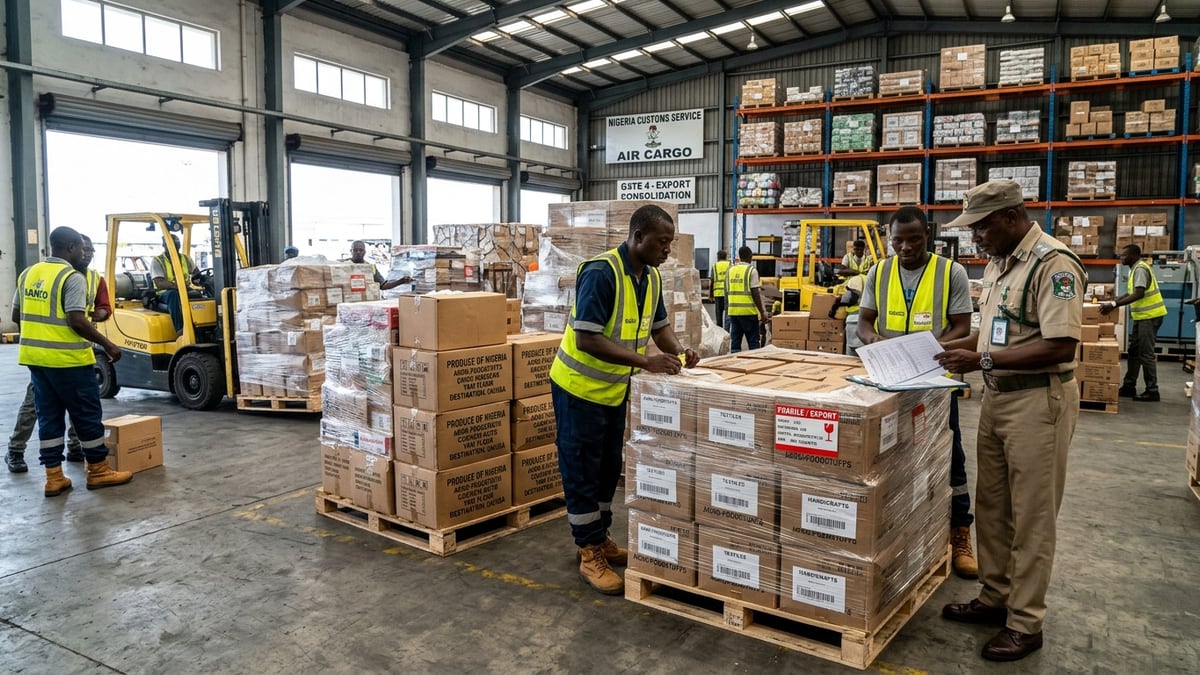
Key Takeaway: Commercial Exporting from Nigeria to the UK
Exporting commercial merchandise from Nigeria to the UK requires five key milestones: (1) Corporate Affairs Commission (CAC) incorporation and an active Nigerian Export Promotion Council (NEPC) certificate; (2) electronic Form NXP registration via an authorized commercial dealer bank on the Central Bank of Nigeria Trade Monitoring System (TRMS); (3) an accurate Commercial Invoice with correct Harmonized System (HS) codes; (4) relevant product health certification (NAQS Phytosanitary or NAFDAC); and (5) a UK importer with a valid GB EORI number. Under the UK Developing Countries Trading Scheme (DCTS), thousands of Nigerian non-oil products enjoy 0% import tariffs.
Nigeria to UK General Export Hub
Shipping rules, rates, drop-off depots, and package tracking.
Exporting Foodstuffs?
View permitted items, vacuum sealing, and DEFRA rules.
Whether you are an established Nigerian manufacturer, an emerging fashion label, an agricultural trader, or an individual sending personal effects and approved dry foodstuffs to family in London, exporting to the United Kingdom represents one of the largest and most lucrative bilateral trade corridors between Africa and Europe.
With bilateral UK-Nigeria trade exceeding £7 billion and a vibrant diaspora community of over 500,000 residents across London, Manchester, Birmingham, Leeds, and Liverpool, demand for authentic Nigerian products—from textiles and cosmetics to dried ginger and packaged foodstuffs—has never been higher.
However, navigating the intersection of Nigerian export regulations (NEPC, Central Bank Form NXP, NAQS) and United Kingdom border controls (HMRC, DEFRA, Food Standards Agency, UK DCTS) requires strict procedural discipline. A single missing phytosanitary certificate, an incorrect Harmonised System (HS) code, or substandard packaging can lead to impounded shipments, heavy demurrage, or outright destruction at British ports of entry.
1. Regulatory Requirements: Getting Started in Nigeria
Before dispatching your first commercial export consignment from Nigeria, federal regulatory frameworks mandate registration with key export oversight bodies.
A. Nigerian Export Promotion Council (NEPC) Exporter Registration
Under the Export (Incentives and Miscellaneous Provisions) Act, any business entity seeking to export commercial cargo out of Nigeria must register with the Nigerian Export Promotion Council (NEPC).
- Eligibility: Must be a registered Nigerian company with the Corporate Affairs Commission (CAC) — Business Names (enterprises) are not permitted to export commercial commodities; only Limited Liability Companies (Ltd) or registered Cooperative Societies are eligible.
- Required Documents: Certificate of Incorporation, Memorandum and Articles of Association, Form CAC 1.1 (Status Report / Particulars of Directors), FIRS Tax Identification Number (TIN), and Board Resolution to register as an exporter.
- Turnaround Time: Online registration through the official NEPC e-portal is typically processed and issued within 48 to 72 working hours.
B. Electronic Form NXP (Non-Oil Export) via CBN TRMS
The Central Bank of Nigeria (CBN) enforces mandatory documentation of all non-oil commercial shipments exceeding $1,000 in commercial value via the Trade Monitoring System (TRMS):
- You must open a dedicated Export Proceeds Account with a licensed Nigerian commercial bank.
- The electronic Form NXP must be initiated online through the TRMS portal before cargo is presented for Nigerian Customs Service (NCS) inspection.
- Once inspected by a government-appointed Pre-Shipment Inspection Agent (such as Cobalt, Neroli, or Arlington), a Clean Certificate of Inspection (CCI) is issued, authorizing customs dispatch.
C. Inspection & Phytosanitary Clearances (Agro & Foodstuffs)
If your consignment includes agricultural produce, seeds, timber, or dried food:
- Nigeria Agricultural Quarantine Service (NAQS): Inspects agricultural goods to ensure freedom from quarantine pests, issuing an official NAQS Phytosanitary Certificate.
- Federal Ministry of Industry, Trade and Investment (FMITI): Issues the Federal Certificate of Origin and Export Quality Certificates where applicable.
2. UK Import Tariffs: Maximising the UK DCTS Scheme
Following the United Kingdom departure from the European Union, the British government established the Developing Countries Trading Scheme (DCTS) in June 2023, offering one of the most generous trade preference schemes in the world.
Key Advantages of the UK DCTS for Nigerian Exporters:
- 0% Customs Duty (Duty-Free Access): Over 85% of tariff lines enter the UK tariff-free. This includes agricultural commodities such as cocoa beans, sesame seeds, cashew nuts, ginger, shea butter, and natural gum, as well as manufactured garments and fashion accessories.
- Simplified Rules of Origin: Exporters must ensure their commercial invoice clearly declares the country of origin as Nigeria (
Origin: Nigeria) and references DCTS qualifying criteria. - Value Added Tax (VAT): Even when customs duty is 0%, standard UK import VAT (20%) applies to most taxable commercial goods unless the product is zero-rated (such as most staple human foodstuffs, books, and children clothes).
3. Shipping Food Products: Legal vs Strictly Prohibited Items
The United Kingdom enforces rigorous biosecurity and public health standards overseen by the Department for Environment, Food & Rural Affairs (DEFRA) and the Food Standards Agency (FSA).
Permitted Food Items (Dry & Vacuum-Packed)
Allowed when completely dehydrated, commercially sealed, and labeled:
- Dried Vegetables: Bitter leaf, scent leaf, ukazi, utazi, and fluted pumpkin (ugwu)—thoroughly oven-dehydrated.
- Ground Spices: Crayfish (finely blended and vacuum-sealed), dry pepper, uziza seeds, ehuru, locust beans (iru/dawadawa).
- Tubers & Flours: Yam flour (elubo), plantain flour, cassava flour, packaged garri (ijebu and white).
- Seeds & Melons: Egusi (peeled and dry), ogbono, sesame seeds, cashew nuts, roasted groundnuts.
- Smoked & Dried Fish: Mangala, stockfish, and catfish—provided zero moisture content and commercially heat-sealed.
Strictly Prohibited & Restricted Items
Will be seized and incinerated immediately by UK Border Force:
- Fresh or Uncooked Meat: Beef, goat meat, poultry, pork, bushmeat, suya, or kilishi without certified commercial sterilization.
- Dairy Products: Unpasteurised milk, fresh cheeses, or butter made from raw animal dairy.
- Fresh Perishables: Fresh oranges, mangoes, garden eggs, fresh pepper, or yams with raw soil attached.
- Controlled Substances: Unlabeled traditional herbal concoctions (agbo), unsealed liquids, or unverified bark powders.
4. County Cargo Service Levels: Nigeria to the UK
County Cargo operates scheduled commercial air logistics, courier services, and direct air freight lanes connecting Lagos (Murtala Muhammed International Airport) and Abuja (Nnamdi Azikiwe International Airport) directly with London Heathrow and our Liverpool UK Distribution Depot.
| Feature | Value Shipping (Air Cargo) | Express Shipping (Priority) | Special Express (48-Hour) |
|---|---|---|---|
| Ideal For | Bulk commercial cargo, large boxes, personal effects, dry foodstuffs | Fast commercial samples, ecommerce parcels, urgent inventory | Critical documents, time-sensitive medical products, VIP cargo |
| Transit Time | 5–10 working days | 3 to 5 working days | 48-Hour Flight Schedule |
| Minimum Weight | 10 kg | 0.5 kg | 1 kg |
| Origin Depots | Lagos Hub (Ladipo-Oshodi) & Abuja (Wuye Market) | Nationwide Doorstep Collection or Hubs | Direct Lagos / Abuja Airport Express |
| UK Destination | London, Manchester, Birmingham, Nationwide UK | Nationwide UK Doorstep Delivery | Direct London Heathrow Clearance |
| Tracking | Milestone tracking updates | Real-time global courier tracking | Priority real-time dispatch alerts |
| Customs Handover | Consolidated clearance included | Express priority clearance | Top direct priority flight connection |
5. Step-by-Step Export Checklist: From Warehouse to UK Doorstep
Confirm Product Eligibility & HS Code Classification
Verify that your items are permitted under UK DEFRA/HMRC guidelines and assign the correct 6-digit to 10-digit Harmonized System (HS) code for 0% DCTS preferential tariff treatment.
Industrial Packaging & Vacuum Sealing
Vacuum-pack organic food items, wrap fragile goods with high-density bubble wrap, and pack into certified heavy-duty 5-ply export cartons rated for international air transit.
Complete Commercial Invoice & Packing List
Generate clear, unambiguous documentation detailing itemized product descriptions, declared values in GBP/USD, origin declarations, and complete consignee contact details.
Drop Off or Request Doorstep Collection
Hand over your consignment at County Cargo Lagos Hub (Ladipo-Oshodi Plaza) or Abuja Hub (Wuye Ultra Modern Market). Alternatively, schedule certified doorstep collection across Nigeria.
Export Inspection & Scheduled Flight Dispatch
Consignments undergo mandatory Nigerian export security screening and customs manifest verification before departing on scheduled direct air cargo flights to London.
UK Customs Clearance & Doorstep Delivery
Cleared through HMRC CDS at London Heathrow and routed through our Liverpool logistics depot (Queens Dock, L1 0BG) for final doorstep delivery nationwide across England, Scotland, Wales, and Northern Ireland.
Start Your Nigeria-to-UK Export Consignment
Get an instant quote with our central rate calculator, book online in minutes, or connect directly with our international trade compliance team.
Related Shipping Guides & Useful Resources
Complete Shipping to Nigeria Guide
The master pillar guide covering air freight, sea freight, rates, timelines and customs.
Nigeria Customs Clearance Guide
Detailed breakdown of Form M, PAAR, duty calculations, and customs processing at Lagos ports.
Cargo Shipping Cost to Nigeria
Transparent pricing rules, actual vs volumetric weight explanations, and fee breakdowns.
UK to Nigeria Shipping Time
Compare express air cargo (3–5 working days), standard air (5–10 working days) and sea cargo (4 to 8 weeks) timelines.